7 Reasons You Shouldn't Paint Your Own House
Table of Contents
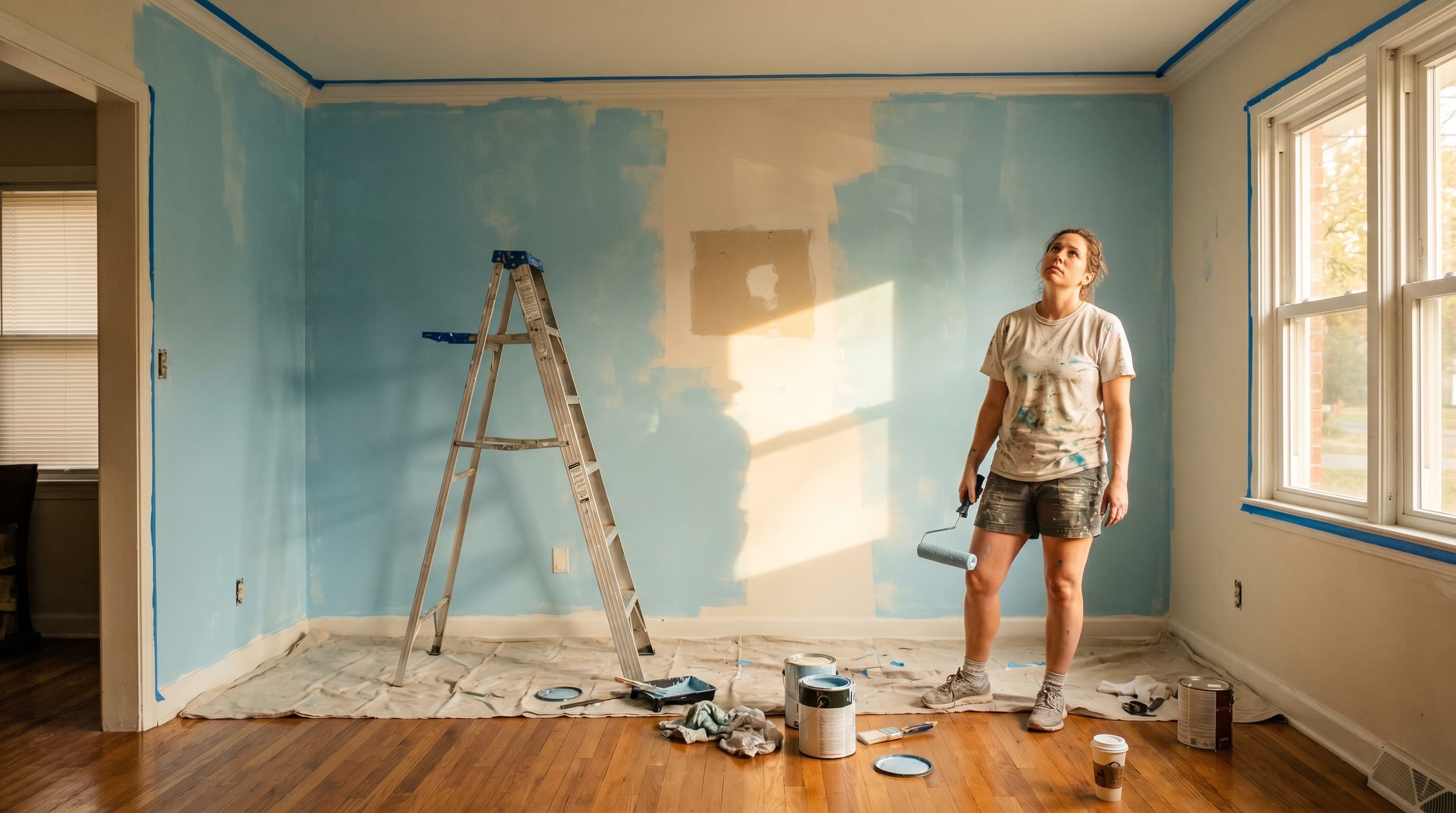
Every spring in Nashville, somebody we know starts a paint project on a Saturday morning with a can of Sherwin-Williams and a lot of confidence. By Sunday night, half the trim is done, the kitchen is taped off in a way that's blocking the coffee maker, and there's a quiet conversation happening about whether to keep going or call somebody.
We're not here to talk you out of it. Painting your own house is a legitimate option — and we'll be the first to tell you when it's the right call. But after a decade of finishing other people's "I'll just do it myself" projects, we can tell you the reasons most homeowners regret starting are pretty consistent. Here are seven of them.
1. The Math On Your Time Doesn't Work
The honest version of "I can paint this room in a weekend" is usually three weekends. A pro crew can knock out a typical Nashville bedroom — walls, ceiling, trim, two coats — in less than a day because they're not doing it for the first time. You are.
For a whole-home interior, you're looking at 40–80 hours of actual work. Add the prep, the runs to the store, the cleanup, and the days you couldn't quite get to it. If your time is worth anything to you, the math gets uncomfortable fast.
Project | DIY Time (Realistic) | Pro Time |
|---|---|---|
Single bedroom | 1–2 weekends | ½–1 day |
Whole-home interior (2,000 sq ft) | 3–6 weeks of evenings/weekends | 3–5 days |
Kitchen cabinets | 2–3 weeks (often longer) | 5–7 days |
Two-story exterior | 4–8 weekends (weather permitting) | 4–7 days |
Deck refinishing | 2–3 weekends | 2–4 days |
2. Prep Is The Job — And It's What Most DIYers Skip
If you walk through a finished room and the paint looks bad, it's almost never the paint. It's the prep. Filling nail holes, sanding patches flat, cleaning grease off kitchen walls, scraping flaking exterior, caulking gaps in trim — that's where 60–70% of a real paint job lives.
Skipping it is what makes a DIY job look like a DIY job. The roller marks, the bumpy patches that show through under raking light, the trim line that wanders — every one of those is a prep step that didn't happen. Our team's interior painting process spends more time on prep than on actual painting, and that ratio is the difference.
3. Ladders, Roofs, and Two-Story Exteriors
This is the one we get most serious about. Most home painting injuries aren't paint-related — they're ladder-related. The CDC and OSHA have published the numbers and they aren't subtle. Falls from ladders send tens of thousands of people to the ER every year, and most of them are homeowners doing exactly the project you're thinking about.
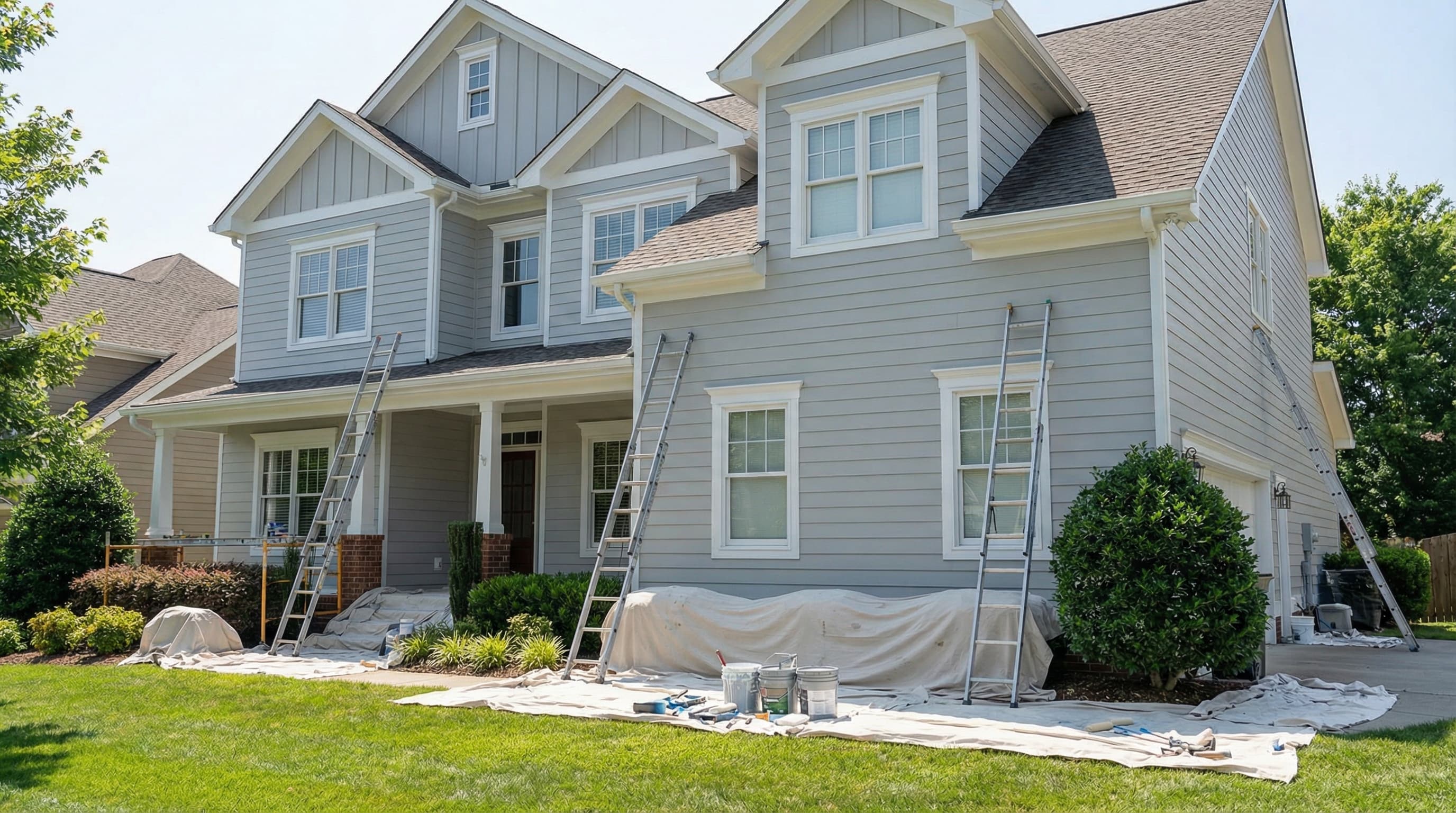
If your house is one story and you're comfortable on a six-foot ladder, that risk is manageable. If you're talking about a two-story Germantown exterior, gable ends, dormers, or anything involving a roof line, the calculus changes. We carry insurance and our crew is trained on extension ladders, scaffolding, and lift work. You probably aren't, and shouldn't pretend to be.
4. Paint Chemistry Is More Complicated Than the Aisle Suggests
Walk into any paint store and you'll see a wall of cans that all look the same. They aren't. The differences between a good cabinet enamel, a bathroom-grade wall paint, an exterior acrylic, and a deck stain are not marketing differences — they're chemical differences that determine how long the finish actually lasts.
For example: Benjamin Moore Advance is what we use on cabinets because it's a waterborne alkyd that levels and cures hard. Ordinary wall paint on cabinets will peel off the rails inside a year, no matter how well you prep. Sherwin-Williams Emerald exterior is engineered for the freeze-thaw cycle Nashville exteriors get every February, where a cheaper exterior latex will crack and chalk. The label tells you almost none of this.
Sheen, drying time, and recoat windows
Even within the right product line, the wrong sheen on the wrong wall is a finish you'll be looking at for ten years. And if you recoat outside the manufacturer's window — too soon or too late — you can compromise the bond on the entire surface. Pros know these windows by feel. DIYers usually don't read them.
5. The Finish Is Unforgiving
Paint is the most visible finish in your house. Every wall, every door, every piece of trim, every soffit — it's all paint, and it's all in your line of sight every day. A flooring mistake can be hidden under a rug. A paint mistake can't.
The hard truth is that an okay paint job looks worse, not better, after the room is furnished and lit properly. Lap marks, holidays (missed spots), uneven cut lines at the ceiling, brush strokes in trim — they all show up at 7 PM with the lamps on, when you're trying to enjoy the room you just spent three weekends painting.
6. You'll Spend More Than You Think
This one surprises most people. The materials cost on a "free" DIY paint job adds up faster than the bid you didn't get. Here's a realistic count for a single bedroom:
Item | Notes |
|---|---|
Paint (2 gallons, decent quality) | Walls + ceiling |
Trim/door enamel (1 quart) | Different product than wall paint |
Primer (if needed) | Stain blocker, drywall patches, dark colors |
Brushes, rollers, frames, trays | Quality brushes alone run real money |
Tape, drop cloths, plastic, caulk, spackle, sandpaper | The "small stuff" that adds up |
Mistakes — extra paint, extra trips | Almost always happens |
For a whole-home project, the materials column alone gets into four figures fast. Now compare that against a pro quote where the labor, materials, prep, cleanup, and warranty are bundled — and the gap is usually narrower than people expect. We've had homeowners price the project two ways and decide the bid was the better deal once they were honest about the materials list.
7. The Job Doesn't End When You're Done
Cleanup is part of the job. Brushes have to be washed properly or thrown out. Rollers get tossed. Drop cloths get folded. Paint cans have to be stored or disposed of correctly. The ladders go back in the garage. The trim tape comes off — and if you wait too long, it pulls the new finish with it.
This is the part that drags out for two more weekends after you "finished" painting. When we do a job, the cleanup is part of the same week. When you do it yourself, the cleanup is what makes your spouse stop asking when this project will be done.
When DIY Actually Does Make Sense
We'll be straight with you. There are projects where DIY is the right answer, and we'd rather tell you that than sell you a quote you don't need.
A single accent wall in a small room with no trim involved
A touch-up of an existing color where you have the original paint
A child's room or a low-stakes space where you genuinely enjoy the project
A small piece of furniture or a single door
If the project is whole rooms, exteriors, cabinets, decks, or anything involving a ladder over six feet — that's where the math turns and a pro almost always pays for itself. The PDCA (Painting Contractors Association) publishes industry standards for what a professional paint job actually entails, and it's a useful reality check before you decide.
Why Choose Those Guys Painting Co.
We quote remotely — send us photos and a quick description of your project, and you'll have a fixed-price quote within 24 hours. No salesperson at your door, no all-day appointment to schedule, no pressure. The person who quotes the job is also a painter, so the scope you get is the scope we actually do. Andrew Hawks and the crew have been finishing Nashville homes the way we'd finish our own since 2024, and the quoting process itself is built around the way real homeowners actually want to make a decision.
Get Your Free Painting Quote
If you've read this far and you're leaning toward letting somebody else handle it, we'd be glad to be that somebody. Fill out the form below — photos of your project and a brief description is all we need. Fixed-price quote within 24 hours.
Frequently Asked Questions
Is it really cheaper to paint your own house?
Sometimes — for a small, low-stakes room, yes. For whole-home interiors, exteriors, or cabinets, the materials cost plus the realistic time investment usually closes most of the gap on a pro quote. The bigger question is whether the finish quality justifies the savings, and for most homeowners in Nashville, it doesn't.
How long does a DIY interior paint job actually take?
Plan on 6–10 hours per room if you're doing real prep. A whole-home interior will eat 3–6 weeks of evenings and weekends for most homeowners. A pro crew typically finishes the same scope in 3–5 days because of repetition, equipment, and crew size.
What's the most common DIY painting mistake?
Skipping prep. Almost every paint problem we get called to fix — peeling, flashing, lap marks, visible patches — traces back to a prep step that wasn't done. The paint itself is rarely the problem.
Should I paint my kitchen cabinets myself?
We'd push back hard on this one. Cabinet painting is a different process from wall painting — it requires the right enamel, the right spray equipment, and a clean dust-free curing space. Our cabinet projects take 5–7 days for a reason, and a DIY cabinet job that peels in a year is a rough lesson. Get a quote on cabinets before you commit to doing it yourself.
When should I definitely hire a professional painter?
Two-story exteriors, anything involving ladders or roof lines, kitchen cabinets, whole-home interiors, and any project with a deadline (a move-in date, a sale closing, an event). Those are the projects where the cost of getting it wrong — in time, in money, in injury risk — is high enough that the pro quote almost always pays for itself.