How to Tell If Your Drywall Needs Repair Before Painting (Nashville Homeowner's Guide)
Table of Contents
One of the most common questions I get before a quote is some version of: "The walls are in pretty good shape — do we really need to deal with that stuff before painting?"
Sometimes the answer is no. A fresh coat of paint over sound walls that just need color is straightforward. But more often than homeowners expect, the walls have issues that paint alone won't fix — and painting over them without addressing them first is how you end up with a result that looks fine on day one and bad by month three.
This is a practical guide to what to look for, what actually needs to be fixed, and what you can leave alone.
Start With the Right Light
Before you can honestly assess your walls, you need to look at them in raking light — a light source coming from one side at a low angle. A flashlight held parallel to the wall surface works well. This is how painters inspect before we start, and it reveals surface imperfections that flat overhead lighting hides completely.
Most homeowners walk through a room, flip the light on, and think the walls look fine. That same room in raking light often tells a completely different story — dings, ridges, old patch lines, and tape seam shadows that you just can't see otherwise.
Do this before you call anyone. It's the only honest baseline.
Problems That Need to Be Fixed Before Painting
Nail Pops and Screw Pops
These show up as small circular bumps — sometimes with a slight crack ring around them — where a fastener has worked its way back toward the surface. They're extremely common in Nashville homes, both in older construction and in newer builds that have had a few years to settle.
Paint does not fix a nail pop. It covers it briefly, and then the movement that caused the pop keeps going, and within a few months you've got a painted bump. The correct fix is to drive the fastener back in (or drive a new one nearby), fill the divot, sand flush, prime, and paint. Takes about five minutes per pop when you're doing it right.
If you have more than a handful, budget the time to do them all before painting — they're easy to miss one at a time and easy to batch efficiently.
Cracks at Tape Seams
Drywall panels are joined at seams with paper tape embedded in joint compound. When that tape separates from the wall — either because it wasn't properly bonded to begin with, or because the house has moved — you get a crack that runs in a straight line, usually near the ceiling or along a wall edge.
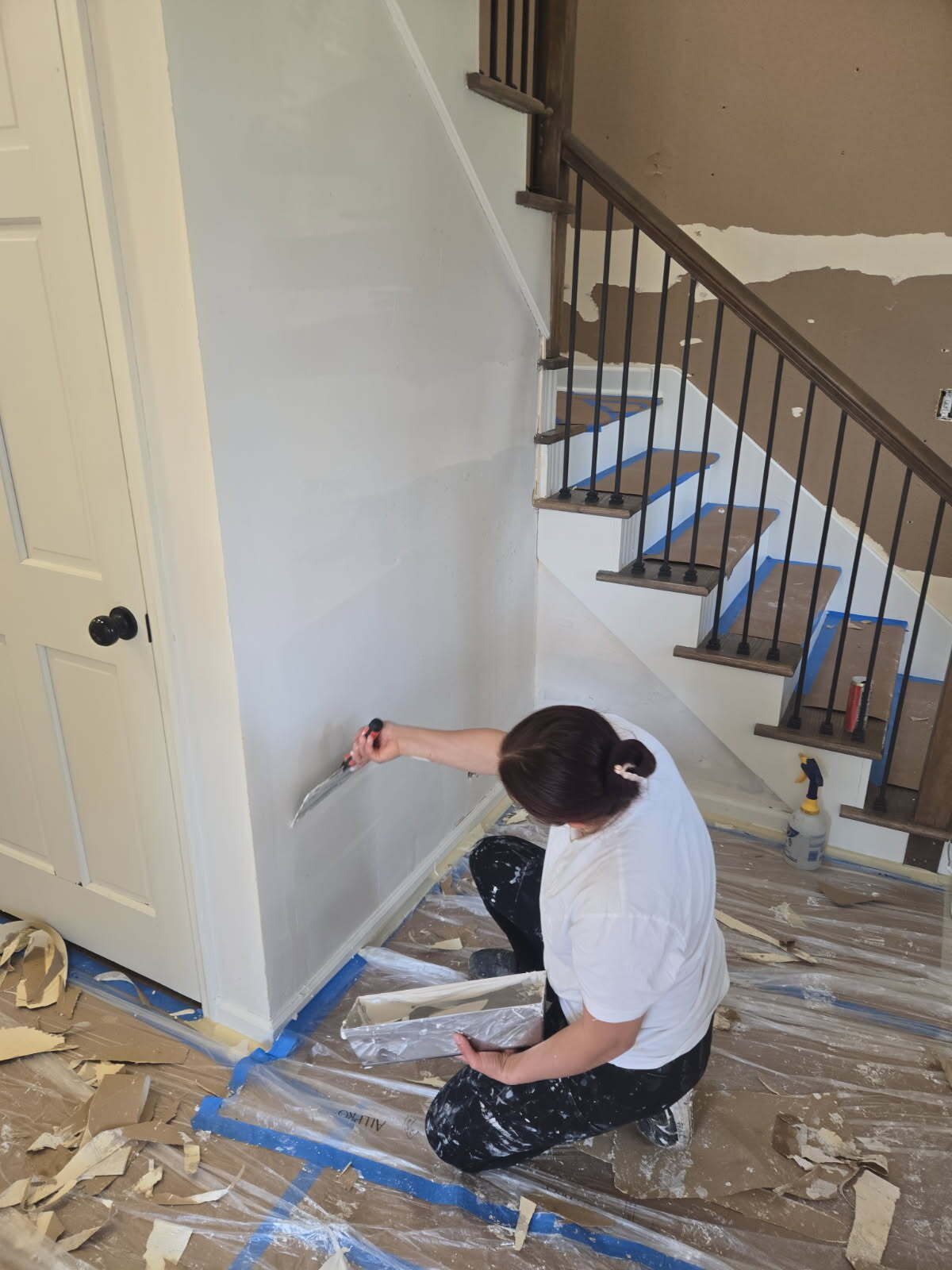
Painting over a separated tape seam will look acceptable for a few weeks and then the crack reappears right through the paint. The fix is to open the seam slightly, re-embed the tape with fresh compound, feather it out over a wide area, sand, prime, and paint. It's more work than a nail pop, but it's not complicated if you're patient with the dry time between coats.
Corner Bead Damage
The metal or vinyl bead on outside corners takes a lot of abuse — furniture bumps, door swings, kids. A dented corner bead creates a visible ridge or dip that gets worse over time. If the bead is still intact but just dented, it can sometimes be filled. If it's bent or separated from the wall, it typically needs to be replaced. Either way, this needs to be addressed before painting — painting over a damaged corner bead just draws attention to it.
Water Stains
A brown or yellow stain on the ceiling or wall tells you water got in somewhere at some point. The question is whether it's an old, resolved issue or an active one.
If the source is still active — a slow roof leak, a bathroom above, a window with bad flashing — painting over the stain is pointless. The stain will bleed through most paints within weeks, and you haven't solved anything. The leak has to be addressed first.
If the source is confirmed resolved, the stain still can't just be painted over with standard interior latex. Water stains require a stain-blocking primer — oil-based or shellac-based — before topcoating. Skip the primer and the stain bleeds through no matter how many coats of paint you apply. I've seen people put four coats of ceiling white on a water stain without priming and still see it.
Soft or Bubbled Drywall
Press on a stained area. If the drywall feels soft, spongy, or moves slightly, the gypsum core has been compromised by moisture and the panel needs to be cut out and replaced — not patched over. Painting compromised drywall just delays the inevitable and usually makes the eventual repair more expensive.
Holes
Anything bigger than a small screw hole needs to be properly patched before painting. Small holes (under about an inch) can be filled with lightweight spackle and sanded flush. Holes in the 1–4 inch range typically need a mesh patch and compound. Larger holes need a backing board and a drywall patch cut to fit.
The mistake most people make with holes is not feathering the compound out wide enough. A patch that's flush in the middle but has visible ridges at the edges is going to show through paint — especially in any kind of angled light. Sand wide, not just at the center of the patch.
Old Patching That Wasn't Primed
If your walls have patches from previous repairs — even good ones — check whether they were ever primed. Bare joint compound absorbs paint at a different rate than the surrounding wall surface, which causes a phenomenon called flashing: the patch looks slightly different in sheen or color even after the paint has dried. You can see it, especially in raking light.
The fix is simple: prime the patch before repainting. If you're repainting a whole room, prime the repaired areas specifically before rolling the full wall. If you just roll two finish coats over an unprimed patch, you may still see it.
Problems That Probably Don't Need Repair
Minor Surface Scratches and Scuffs
Light surface scratches that haven't broken through the drywall paper can usually be painted over without repair, especially if you're applying two coats. If the scratch is raised (a ridge rather than a divot), knock it down lightly with 120-grit sandpaper before painting.
Small Hairline Cracks in Paint (Not Tape)
Hairline cracks in the paint surface itself — not at a tape seam, not following a structural line — are often just old paint that's gotten brittle. These can typically be sanded lightly and painted over without compound. If they reappear after repainting, then you've got a substrate issue worth investigating further.
Normal Surface Variations in Older Plaster
Nashville has a lot of older homes with plaster walls. Plaster has a different look than drywall — slight undulations, subtle texture variation — and that's normal and appropriate for the material. Trying to skim coat plaster walls to a perfectly flat drywall-smooth finish is a significant job and usually not worth it unless you have specific finish goals. For most interior painting on plaster, clean the surface, prime where needed, and paint.
The Texture Matching Question
One thing worth flagging separately: if your walls have texture — orange peel, knockdown, skip trowel — any repaired area needs to have that texture re-applied before painting, or the patch will be visible as a smooth spot in a textured wall.
Orange peel and light knockdown are achievable with a rented hopper gun or even a can of spray texture for small repairs. Heavier or more complex textures are harder to match. When in doubt, test the texture on a scrap piece of drywall before touching the wall.
If texture matching isn't feasible on a given repair, sometimes the right answer is to spray the full wall rather than try to blend. It depends on the scope and the customer's tolerance for imperfection.
When to Call Someone
Most of what I've described above is DIY-able if you have patience and are willing to let compound dry properly between coats. The two things that tend to go wrong for homeowners are rushing dry time and not feathering compound wide enough.
Where it usually makes sense to bring in a pro: when you have extensive repairs across multiple surfaces, when texture matching is required, when you're dealing with water damage that may have compromised multiple panels, or when you're repainting in preparation for a sale and the finish needs to be clean enough to hold up to buyer scrutiny.
If you're in the Nashville area and want a straight answer on whether your walls need work before painting — send photos. I'll tell you honestly what I see and what it would cost to handle it.
Call (615) 638-7642 or email manager@thoseguyspaintingco.com.
]]>
Frequently Asked Questions
Can you just paint over nail pops?
No — paint covers a nail pop temporarily, but the underlying movement continues and the bump reappears through the paint. The fix is quick: set the fastener, fill the divot, sand, prime, and paint.
Do water stains need special treatment before painting?
Yes. Water stains bleed through standard interior paint no matter how many coats you apply. You need a stain-blocking primer (oil-based or shellac-based) over the stain before topcoating. The source of the leak also needs to be resolved first if it hasn't been already.
How do you tell if drywall needs to be replaced vs. just patched?
Press on the damaged area. If it feels soft, spongy, or moves, the gypsum core has been compromised by moisture and the panel needs to be cut out and replaced. If it's firm and the damage is just surface-level, patching is usually sufficient.
Why does a patched area look different after painting?
Most likely the patch wasn't primed. Bare joint compound absorbs paint differently than the surrounding wall, causing a sheen or color difference called flashing. Prime repaired areas before applying finish coats and the problem goes away.